- Your cart is empty
- Continue Shopping

Technical Selection Guide | Laboratory Equipment
Difference Between Lab Oven and Lab Furnace
While both are essential thermal processing equipment in modern laboratories, they differ radically in operating temperatures, heating mechanisms, chamber insulation, and target applications. Learn how to select the right system for your research, quality testing, or industrial production.
Lab Oven: Ambient +5°C to 300°C / 450°C
Lab Furnace: 500°C to 1800°C Ultra-High Temp
Convection Airflow vs Radiant Muffle Heat
Glassware Drying vs Sample Ashing & Sintering
Side-By-Side Visual Guide
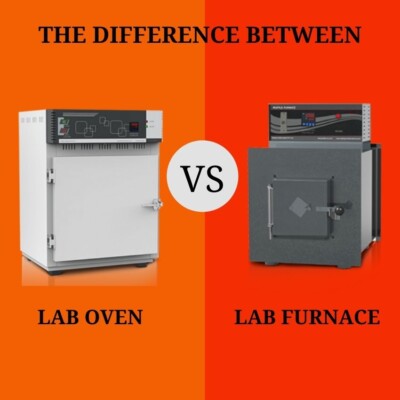
Laboratory Oven
Drying & Sterilization
Laboratory Furnace
Ashing & High Temp Heat
Lab Oven Temp
Up to 300°C
Air Convection Heating
Lab Furnace Temp
1000°C - 1800°C
Refractory Muffle Heat
Oven Primary Goal
Dehydration
Drying, Baking & Moisture Loss
Furnace Primary Goal
Combustion
Ashing, Calcination & Sintering
Fundamental Analysis
Core Differences: Oven vs. Furnace
Understanding temperature limits, airflow dynamics, insulation types, and sample reactions is vital for selecting the correct unit.
Laboratory Hot Air Oven
Convection-Driven Low to Medium Temperature Systems
A laboratory oven operates primarily through forced or natural convection airflow. Air is heated via tubular elements and circulated evenly throughout an insulated chamber. Ovens are ideal for tasks where sample moisture must be driven off without destroying the sample substrate.
Temperature Range: Ambient +5°C to 300°C (Specialized up to 450°C)
Designed for controlled thermal profiles without reaching temperatures that cause thermal decomposition or melting of metals.
Airflow Dynamics: Forced Blower or Gravity Convection
Features motorized fans and exhaust vents to continuously flush out evaporated moisture and maintain high temperature uniformity (±1.0°C).
Chamber Material: Stainless Steel (SS 304 / SS 316)
Constructed with high-polish stainless steel interiors, glass wool / mineral wool insulation, and silicone door seals.
Common Applications:
- Glassware & instrument drying / sterilization
- Moisture determination and loss on drying (LOD)
- Polymer curing, annealing, and paint baking
- Stability testing and electronic component baking
Laboratory Muffle / Tube Furnace
Radiant-Driven Extreme High Temperature Systems
A laboratory furnace (often called a muffle or tube furnace) achieves extreme thermal conditions by transferring radiant heat from embedded heating elements through ceramic or refractory muffle walls without forced airflow.
Temperature Range: 500°C to 1800°C+
Designed for extreme thermal processes like complete sample organic combustion, metal heat treating, or ceramic sintering.
Airflow Dynamics: Radiant Heat (Minimal Air Movement)
Air blowers cannot survive these temperatures; heat radiates directly from SiC, Kanthal, or MoSi2 heating elements inside refractory lining.
Chamber Material: Refractory Ceramic & Fiber Boards
Constructed with high-purity alumina fiber insulation, refractory muffle bricks, and heavy steel outer shell with double-fan cooling.
Common Applications:
- Ashing organic samples (Food, Coal, Pharma)
- Loss on Ignition (LOI) & Calcination
- Ceramic sintering, glass melting & metallurgical annealing
- Thermal stress analysis & material synthesis
Engineering Comparison
Chamber Architecture & Heating Elements
Comparing the mechanical design and component selection between ovens and furnaces.
O
Lab Oven Construction Architecture
Optimized for convective airflow & fast heat transfer
Outer Shell:
CRCA Sheet powder-coated or Grade 304 Matt finished Stainless Steel.
Inner Chamber:
Stainless Steel 304/316 with mirror polish and shelf runner ribs.
Insulation:
3″ thick high-density resin bonded Glass Wool insulation (Up to 300°C).
Heater Type:
U-shaped Nichrome tubular air heaters placed in side or bottom air ducts.
Sensor Type:
Pt-100 Class A Duplex RTD Sensor (Accuracy ±0.1°C).
F
Lab Furnace Construction Architecture
Optimized for extreme heat containment & thermal radiation
Outer Shell:
Heavy-gauge dual-casing steel with air jacket cooling fans to keep exterior safe.
Inner Muffle:
High-alumina ceramic muffle chamber or vacuum-formed ceramic fiber board.
Insulation:
Multi-layer Ceramic Fiber blankets & Refractory Firebricks (Up to 1800°C).
Heater Type:
Kanthal A1 wire (1200°C), Silicon Carbide SiC (1400°C), or MoSi2 Rods (1800°C).
Sensor Type:
Thermocouples: Type K (1200°C), Type S (1400°C), or Type B (1800°C).
Interactive Tool
Which Equipment Do You Need?
Select your application parameters below to get an instant equipment recommendation.
Recommended System Configuration
Forced Convection Laboratory Hot Air Oven
Ideal for uniform moisture removal and glassware drying up to 250°C with forced air recirculation.
Quick Reference Matrix
Side-by-Side Comparison Matrix
A side-by-side technical summary comparing performance parameters of ovens and furnaces.
| Feature / Parameter | Laboratory Oven | Laboratory Furnace (Muffle) |
|---|---|---|
| Operating Temperature | Ambient +5°C to 300°C (Max 450°C) | 500°C to 1800°C |
| Heat Transfer Mode | Forced Blower or Natural Convection Airflow | Direct Radiant Thermal Heat |
| Chamber Liner Material | Stainless Steel 304 / 316 Grade | Ceramic Muffle / Refractory Alumina Fiber Board |
| Insulation Material | High-Density Glass Wool / Mineral Wool | Ceramic Fiber Blanket / Refractory Firebrick |
| Air Circulation Blower | Yes (Motorized Blower Fan included) | No (Fan cannot survive furnace temps) |
| Temperature Sensor | Pt-100 RTD Sensor (High Accuracy ±0.1°C) | Thermocouple (Type K, Type S, or Type B) |
| Sample Container Type | Perforated SS Trays, Glass Beakers, Flasks | High-Purity Ceramic or Silica Crucibles |
| Primary Goal / Process | Dehydration, Baking, Sterilization, LOD | Combustion, Ashing, Calcination, Sintering |
| Power Consumption | Moderate (1.5 kW to 6.0 kW) | High (3.5 kW to 18.0 kW+) |
Equipment Catalog
Tempo Product Series Overview
Available standard capacities and customizable options built to GMP & ISO standards.
Series TI-HO & TI-FO
28L to 450L
Tempo Precision Laboratory Ovens
- Microprocessor PID Controller with Auto-tune (±0.5°C)
- SS 304 / SS 316 Interior with adjustable perforated trays
- Optional 21 CFR Part 11 Audit Trail & Data Logging Software
Series TI-MF & TI-TF
1100°C to 1800°C
Tempo Muffle & Tube Furnaces
- Programmable Multi-segment PID Controllers with Ramp & Soak
- Lightweight ceramic fiber muffle for ultra-fast heating
- Safety door cut-off switch and over-temperature alarm
Technical RFQ Request
Request Equipment Quotation or Advice
Submit your thermal application details below. Our engineering team will respond within 24 hours.