- Your cart is empty
- Continue Shopping

Tempo Engineering Knowledge Series
Hot Air Oven Selection:
The Definitive Guide
A comprehensive technical resource for laboratory managers, quality control leads, and pharmaceutical engineers. Learn how to evaluate airflow convection dynamics, temperature range precision, material of construction (MOC), and compliance standards for optimal dry heat processing.
Natural vs. Forced Air Circulation
Dry Heat Sterilization Protocols
SS 304 / 316 Triple-Walled MOC
21 CFR Part 11 Software Ready
Featured Guide
Temperature Uniformity
±1.0°C Calibration
Capacity Range
28 Litres to 500+ Litres
50°C - 300°C
Standard Temp Operational Range
±0.5°C
PID Controller Accuracy
Triple-Walled
Insulated Energy Saving Shell
21 CFR Part 11
GMP & Pharma Audit Compliant
Fundamental Principles
What is a Hot Air Oven & How Does it Work?
A Hot Air Oven is an electrical laboratory instrument designed to utilize dry heat thermal energy to sterilize, dry, heat-treat, or age samples. Unlike moist heat sterilization systems (autoclaves) that use pressurized steam, hot air ovens operate using forced or natural circulation of superheated air at atmospheric pressure.
Dry heat destroys microorganisms through oxidation of cellular components and denaturation of vital proteins. It is the primary sterilization method for items that can be damaged by moisture, steam condensation, or rust—such as glass Petri dishes, metal surgical tools, powders, oily substances, and sealed glass ampoules.
Standard Dry Heat Sterilization Parameters
- 160°C (320°F): Requires 120 minutes (2 Hours) soak time
- 170°C (340°F): Requires 60 minutes (1 Hour) soak time
- 180°C (356°F): Requires 30 minutes soak time
- 250°C (482°F)+: Depyrogenation for removing bacterial endotoxins
Dry Heat vs. Moist Heat Comparison
Hot Air Oven (Dry Heat)
Penetrates slowly via conduction; ideal for glass, metals, powders, and non-aqueous liquids. Prevents corrosion and moisture condensation.
Autoclave (Moist Steam Heat)
Penetrates rapidly via latent heat; ideal for culture media, bio-hazardous waste, and rubber products. Causes rusting on carbon tools.
Engineering Anatomy
Anatomy & Structural Components
Tempo Hot Air Ovens are engineered for minimal thermal leakage, high longevity, and precision airflow.
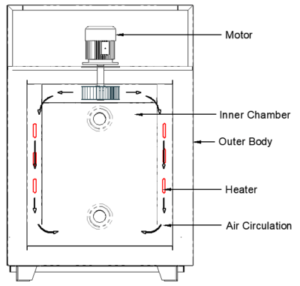
Triple-Walled Airflow & Heating Duct Schematic
1
Triple-Walled Construction
Inner chamber in SS 304/316, outer mild steel powder-coated or stainless steel, with intermediate heating plenum.
2
High-Density Glass Wool
3-inch thick insulation layer prevents skin temperature hazards and minimizes heat dissipation to lower energy costs.
3
Sheathed Tubular Heaters
High-grade Nichrome A-1 tubular elements placed along side/bottom ducts to prevent direct radiant scorching.
4
Forced Blower Fan
Dynamically balanced motor impeller recirculates hot air continuously for spatial uniformity (±1.0°C).
5
PID Microprocessor
Self-tuning controller with dual LED displays showing Set Value (SV) and Process Value (PV) in real time.
6
Perforated SS Trays
Electropolished mesh shelves designed with optimal aperture ratio to maximize vertical air penetration.
7
Pt-100 RTD Sensor
Class-A duplex platinum resistance thermometer sensor for millidegree temperature feedback sensitivity.
8
Safety Over-Temp Cutoff
Independent hydraulic safety thermostat isolates heating circuit if primary controller encounters fault.
Classification
Hot Air Oven Convection Types
Choosing between natural convection and forced air circulation depends on sample weight and drying requirements.
01
Natural Gravity Convection
Hot air rises naturally as density decreases, creating low-velocity thermal circulation without fans. Perfect for fine powders, light soil samples, or delicate chemicals that would blow away.
Air Velocity:
Zero (Gravity Only)
Uniformity:
±2.5°C to ±3.0°C
Best For:
Powders & Granules
Industry Standard
02
Forced Air Blower Convection
Motorized fans force pre-heated air through horizontal or vertical plenum ducts. Delivers ultra-fast heat transfer, rapid temperature recovery upon door opening, and uniform heating across all shelves.
Air Velocity:
High (Motorized Blower)
Uniformity:
±0.5°C to ±1.0°C
Best For:
Glassware & Rapid Drying
03
Side Draught High Velocity
Features specialized horizontal side-to-side cross-ventilation channels. Ideal for heavy density loads, tray drying with high moisture evaporation, and high-temperature baking up to 450°C.
Air Movement:
Lateral Cross-Flow
Temp Limits:
Up to 450°C
Best For:
Heavy Industrial / Moisture
Buyer Checklist
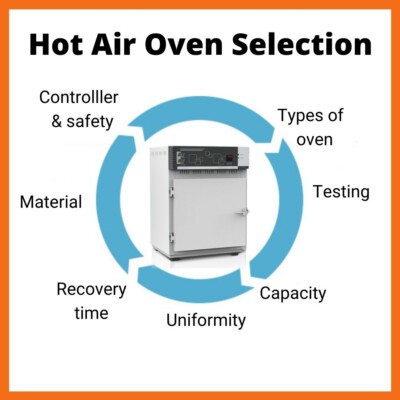
6 Key Factors for Hot Air Oven Selection
Follow this evaluation matrix before specifying equipment for your laboratory or factory floor.
FACTOR 01
Operating Temperature & Uniformity
Determine standard routine operating points. Standard lab ovens cover Ambient +5°C to 250°C or 300°C. For depyrogenation, choose high-temperature units reaching 350°C – 450°C.
FACTOR 02
Chamber Capacity & Footprint
Calculate batch loading volumes. Allow 30% spatial allowance between shelves for air movement. Standard chamber sizes range from benchtop 28L to floor-standing 500L+.
FACTOR 03
Material of Construction (MOC)
For standard dry heat, SS 304 grade inner chamber is standard. For corrosive samples, acidic fumes, or pharmaceutical GMP plants, opt for electropolished SS 316 / 316L.
FACTOR 04
Controller & Regulatory Compliance
Pharmaceutical and biotech installations require 21 CFR Part 11 software with audit trail, user hierarchy, electronic signatures, multi-channel data logging, and IQ/OQ/PQ validation.
FACTOR 05
Safety Features & Redundancy
Look for secondary hydraulic cutoffs, door limit switches that stop blowers on opening, door keylocks, audio-visual alarms, and explosion vent port options for volatile solvents.
FACTOR 06
Customizations & Accessories
Assess options such as glass viewing doors, HEPA air filtration inlet, motorized exhaust dampers, custom tray spacings, and RS-485 / Ethernet connectivity.
Interactive Configurator
Hot Air Oven Requirement Assistant
Select your application specifics below to match the ideal Tempo oven model configuration.
Recommended Model Match
TI-HO-FC Series (Forced Air Blower Convection)
High-velocity motorized circulation ensures rapid drying and ±1.0°C spatial uniformity across all glassware trays.
Technical Matrix
Tempo Hot Air Oven Series Specifications
Standard specifications across our model spectrum. Custom chamber sizes and multi-door walk-in designs available.
| Model Series | Circulation Method | Standard Capacities | Operating Temp Range | MOC & Construction | Action |
|---|---|---|---|---|---|
| TI-HO-NC Series | Natural Gravity Convection | 28L, 45L, 91L, 125L, 250L, 340L | Ambient +5°C to 250°C | Triple Walled SS 304 Inner, Glass wool | |
| TI-HO-FC Series | FEATURED Forced Air Blower | 45L, 91L, 125L, 250L, 340L, 500L | Ambient +5°C to 300°C | Triple Walled SS 304 / SS 316 Option | |
| TI-HO-HT Series | Side Draught High Velocity | 125L, 250L, 450L, 800L Walk-in | Ambient +5°C to 450°C High Temp | Heavy Gauge SS 316, Ceramic Fiber Insulation |
Direct Technical Sales Inquiry
Request an Official Equipment Quote
Fill in your requirements below. Inquiries are submitted directly to technical sales.